

Author: Vikram Kumaran & Wookhee Min
Key Ideas
- AI reduces authoring effort. Large language models can transform short story prompts into structured interactive narratives that are automatically compiled into playable 3D experiences.
- Authors maintain control. Educators can edit prompts and intermediate outputs to tailor stories, scenes, and interactions for specific classrooms or learning goals.
- Structured pipelines keep stories coherent. Scenes and story graphs allow branching experiences while preserving narrative logic.
Interactive storytelling has long been a powerful way to engage learners. From early text-based adventures to modern narrative-driven games, stories enable people to explore ideas, make decisions, and see the consequences of their decisions unfold. However, creating interactive narratives, especially those designed for learning, typically requires significant manual scripting and design effort.
Recent advances in artificial intelligence (AI) are helping reduce this barrier. Researchers are developing systems that use large language models (LLMs) to generate interactive narratives from short prompts, helping educators rapidly create structured story experiences.
“AI can transform a short narrative idea into a structured interactive experience with scenes, characters, and dialogue.”
From Story Ideas to Scenes
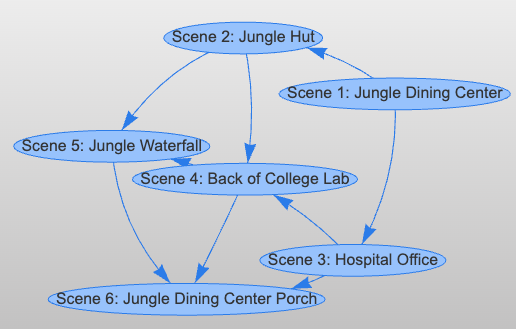
A key concept behind SceneCraft is the idea of scenes or story beats. The idea is to generate and identify important moments that move the story forward. Instead of writing an entire story at once, AI models first translate a high-level prompt into a sequence of these key scenes.
For example, a short prompt describing a mysterious illness on a fish farm might generate scenes such as interviewing local farmers, gathering clues, testing hypotheses, and ultimately solving the problem. These scenes form the backbone of the story and define the progression of events.
Rather than being arranged in a strictly linear sequence, the scenes are organized into a partially ordered event graph. This structure allows players to encounter events in different orders while ensuring that important story dependencies are preserved.
Maintaining Story Coherence with Structured Generation
Large language models are powerful text generators, but without guidance they tend to drift away from an author’s intent. To address this, narrative generation systems typically use multi-stage pipelines that structure the generation process.
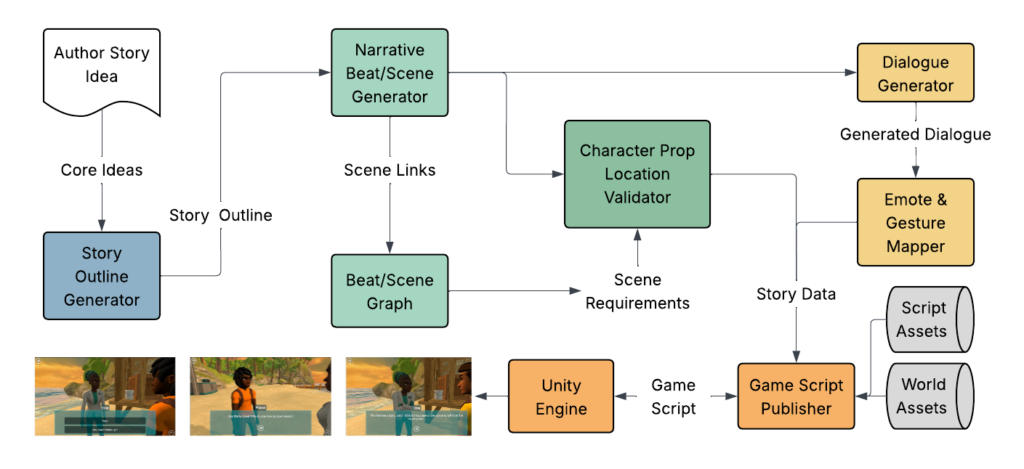
Instead of producing a story in a single step, the system generates the narrative in stages:
- Story outline generation – A short narrative outline is created from the initial prompt.
- Scene generation – The outline is decomposed into key narrative events.
- Dialogue generation – Each scene is expanded into character interactions and dialogue.
- Game scripting – The generated scenes are converted into scripts that can run in a game engine.
This layered approach allows educators to inspect and refine intermediate outputs before the story becomes a playable experience for students.
Author Control and Customization
While AI automates many parts of narrative creation, human authors remain central to the design process. Rather than automatically embedding curriculum goals into the narrative, the system provides multiple points where authors can guide and customize the generation process.
For example, educators can modify:
- the initial story prompt;
- the organization of scenes, scene location and characters present; and
- the prompts used to generate dialogue or character interactions.
They can also edit the generated dialogues to customize to their individual context.
Because these components are generated in stages, authors can adjust them to better match the needs of a particular classroom or learning objective.
“AI helps generate possibilities, but educators remain in control of the story.”
This approach enables educators to adapt interactive narratives to different subjects, grade levels, or instructional goals while still benefiting from the speed of AI-assisted generation.
From Script to Playable 3D Game
SceneCraft automatically produces playable 3D narrative-centered learning experiences. Generated stories are mapped to an asset library of characters and locations.The tool validates that scenes are physically realizable and characters fit in locations, and locations match the author’s prompt.
Each scene is an interactive encounter with dialogue, gestures and emotions, triggered through gameplay. All content is compiled into a script that controls dialogue flow, scene transitions, and game state. The script is then executed in a Unity-based engine, combining narrative logic with game assets to produce a fully playable 3D episode from a simple prompt.

Lowering the Barrier to Interactive Story Design
Creating narrative-centered learning environments has traditionally required expertise in storytelling, game design, and programming. AI-assisted authoring tools aim to lower this barrier by helping educators quickly generate narrative structures, dialogue, and scenes from simple prompts.
Instead of starting from scratch, authors can begin with an AI-generated story scaffold and refine it to suit their goals. This combination of automation and human guidance can significantly accelerate the design process while preserving creative control.
As these tools continue to evolve, they may make it easier for educators to create interactive experiences such as historical investigations, science mysteries, or ethical dilemmas that unfold through narrative exploration.
Stories have always been powerful tools for learning. With the help of AI-assisted authoring tools, creating those stories may soon become far more accessible.
- Contact Us: Learn about upcoming opportunities, events, and more.
- StoryJam Challenges: Join the SceneCraft community through our challenges and earn compensation for your participation!