

Authors: Kelli Paul & Wendy Walter
Key Ideas:
- Game-based learning bridges the gap between scientific inquiry and humanities-based inquiry, highlighting that evidence-based reasoning is a universal skill.
- Narrative-centered, AI-enhanced games like EcoJourneys provide a way to integrate subjects, such as science, social studies, and ELA, rather than adding “one more thing” to an already full curriculum.
- Social studies students leveraged their existing habits of argumentation and evidence-based writing, making the students more resilient to the reading and writing requirements built into the game-based learning environment.
In education, we often talk about silos. Science happens in the lab, and social studies happens in the archives. But real-world problems rarely respect those boundaries.
We created EcoJourneys, a narrative-centered, AI-enhanced game, to support middle school students in learning grade-level ecosystems content while solving real-world environmental problems. In the game, students arrive on a fictional island in the Philippines, assuming the role of scientists investigating why tilapia in a hatchery are getting sick. Designed for a science curriculum, we were intrigued when a social studies teacher reached out asking to use the game with her students. She saw a parallel between the environmental impacts of the 19th century industrial movement and the modern-day ecological crisis on the fictional island in the game. This led us to wonder: How could EcoJourneys fit into a class studying the Industrial Revolution? Could it bridge the two disciplines?
The Discovery: What vs. How and Why
Over the past two years, we have observed multiple teachers use EcoJourneys in science classrooms, typically to reinforce the “What”–the specific parts of an ecosystem and how they interact. They also learned the “How”–the scientific process of identifying and solving a problem. However, when we moved into the social studies classroom, the energy shifted. Here, students continued to focus on the “How,” but they increasingly focused on the “Why.” They noticed the impact of human activity on ecosystems and built arguments to describe their observations. All three questions–What, How, and Why–are necessary for scientific inquiry. We discovered that EcoJourneys surfaced all three questions and served to bridge the gap between the human-centered inquiry of Social Studies and the data-driven inquiry of Science. These are not just scientific skills; they are essential literacy skills.
Beyond the “Ugh”: Pushing Through the Writing Roadblock
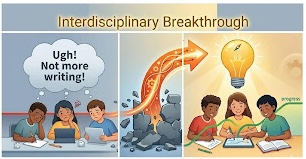
As you might expect, middle school students are not huge fans of writing requirements, especially within the context of a “game.” The amount of reading and writing required is one of the biggest complaints we hear (accompanied by a myriad of groans and audible “Ughs”).
But we noticed a shift in students’ resilience to the writing tasks. The social studies students did not magically stop complaining–we still heard “Not again!”–but their reaction changed. They pushed through the initial groans and completed it together. According to their teacher, their daily curriculum already emphasized “chatting” and justifying answers with evidence. They didn’t see the game’s request for more detail as a penalty; they saw it as part of the process of argumentation they were already used to. The literacy skills developed in the humanities are not separate from science–both are drivers of inquiry.
The Breakthrough: It’s Not “One More Thing”
This experience highlights a major pain point: initiative fatigue. Teachers often view tools like EcoJourneys as “one more thing” to fit into an already full curriculum. However, by focusing on common literacy skills, these tools offer the chance to integrate rather than replace.
- For Science Teachers: Students practice the ELA/literacy standards–providing evidence and reasoning–required on modern science exams.
- For Social Studies Teachers: Students engage with an interactive case study of human-environment interaction that bridges geography and civic standards.
Building a Bridge for Interdisciplinary Inquiry
We learned that EcoJourneys does not just belong in the science classroom but has value across disciplinary boundaries. The evidence-based reasoning used to analyze a primary source in the humanities is the same skill needed to analyze a water quality report in the sciences.
Interdisciplinary teaching does not have to mean rewriting your entire curriculum. Sometimes, all it takes is looking at a science problem through a social lens, or viewing a historical problem through a scientific one. When we invite students to bring their full range of inquiry skills to a challenge, the disciplinary silos disappear. We are no longer just teaching a subject; we are developing holistic thinkers who can see–and solve–the complex problems of the modern world.
Visit our website to find out more about EcoJourneys.
Photo by Allison Shelley for EDUimages