
Author: Wendy Walter & Kelli Paul
Key Ideas
- Shift from single-use materials to durable assets. Upfront investment in a SceneCraft narrative creates a high-value resource that lasts far beyond a single lesson.
- Teachers can act as an architect, building custom worlds from scratch, or curators, pivoting stored stories to different subjects or student levels to save time.
- Reframe AI “trial and error” as a professional process. This iteration ensures creative stories meet strict academic standards while keeping the teacher as the primary decision-maker.
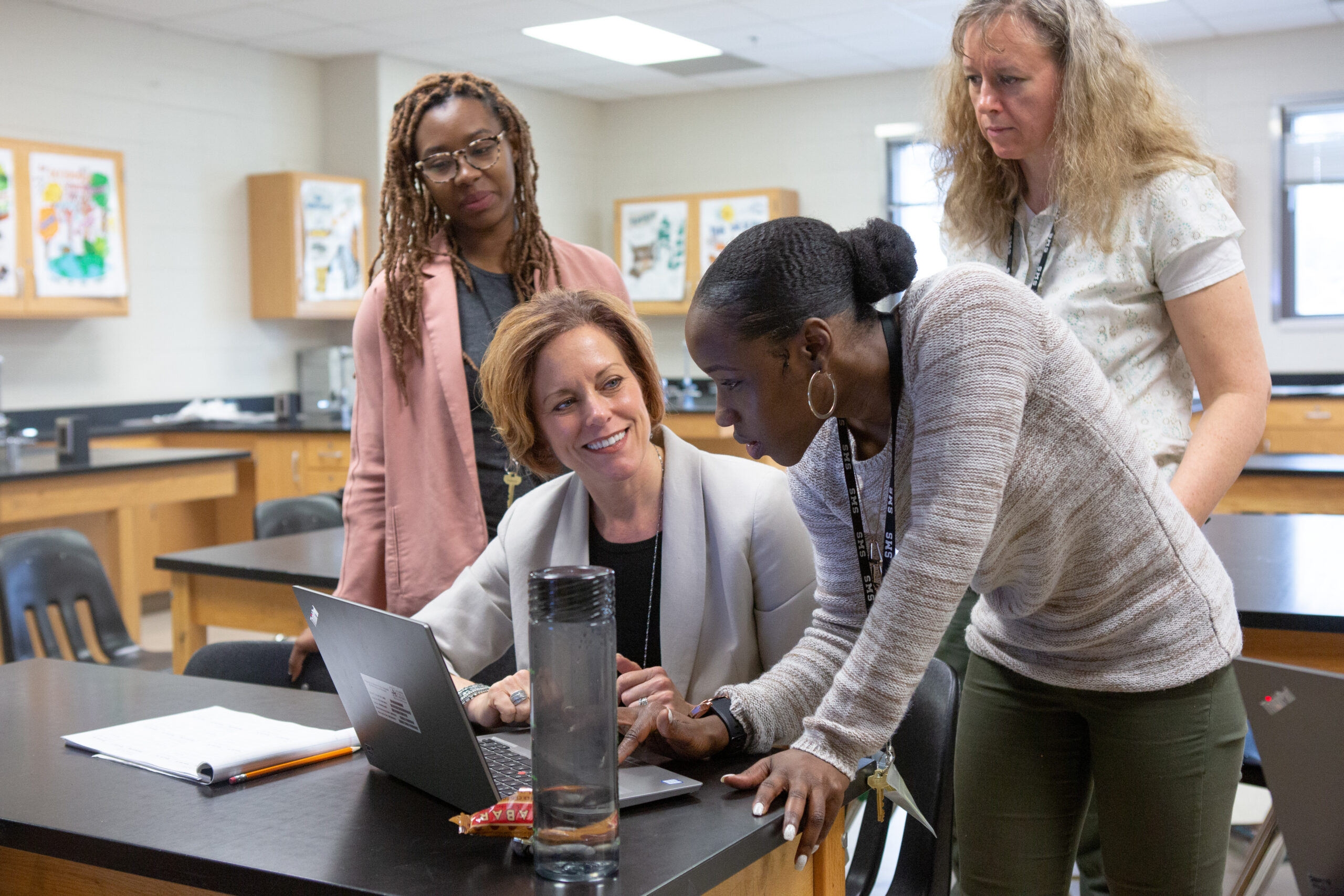
As a research team—one of whom brings the perspective of a veteran educator—we spend a lot of time analyzing the intersection of Generative AI (GenAI) and classroom learning. Recently, we took SceneCraft, our GenAI-powered storytelling platform, on the road in Indiana to share it with our Educator Advisory Board and teachers across the state.
We went in expecting to talk about the technical mechanics of building powerful narratives. We came out talking about time.
There was a moment during our Advisory Board meeting that perfectly captured the tension of the modern classroom. As teachers navigated the “trial and error” of getting a character’s voice just right or refining a scene’s logic, a common sentiment emerged:
“If it takes this much effort to calibrate the AI, why wouldn’t I just skip the SceneCraft narrative planning and write my own?”
It’s a fair, pragmatic question. But as we dug deeper with our board, we realized that this friction isn’t a sign that the tech is failing; it’s a signal that we are shifting the very nature of how curriculum is built. We are moving away from disposable prep and toward durable assets.
The Trap of the “One-and-Done” Cycle
In the day-to-day grind, fast usually wins. We’ve all been there: it’s 7:00 PM, and you need something for tomorrow morning. You whip up a quiz, a worksheet, or a lesson activity. It’s effective for the moment, but it’s essentially a single-use tool. Once the bell rings, that effort often vanishes into a desk drawer or a cluttered digital folder, never to be seen again.
The problem is that disposable prep has a 0% return on investment. You have to do the same amount of work again next week, next month, and next year. SceneCraft invites a different approach—one that treats a teacher’s creative energy as capital rather than cost.
The Pivot: Two Paths in the Narrative Library
We think of SceneCraft not as a simple content generator but as a narrative library. This is the core of our “Long Game” strategy. When a teacher enters the library, they aren’t just looking for a quick fix; they are choosing between two distinct paths of professional craftsmanship, the architect or the curator.
1. The Architect: Building From the Ground Up
This is where the upfront load happens. You spend the time negotiating with the GenAI, iterating on prompts, and fine-tuning characters to ensure they meet your exact standards and stated goals. Yes, it takes more than five minutes. But you aren’t just creating a lesson; you are building a world. Once that world is calibrated, it’s stored in your library—a permanent, high-fidelity asset that you own.
2. The Curator: Starting From the Stored Vision
This is where the time investment pays its dividends. Because narratives are stored and searchable, your next lesson doesn’t start with a blank page. You can enter the library and pull a previously crafted story off the shelf and put it to work again:
- Same world, new objective: Use the same characters from your science unit to tackle a new lesson on ethics.
- Same story, new audience: Take a narrative you built for your honors class and quickly edit the complexity for your introductory learners.
By starting with what’s already in your library, the trial and error disappears, and is replaced by the speed of revision.
Merging Creativity with Standards
Every educator knows the constant pressure to balance high-level student engagement with strict instructional goals. The upfront time spent in SceneCraft ensures that creativity and standards are fused together in a way that lasts.
The teachers in Indiana who felt the friction were actually doing the essential, professional work of aligning a creative spark with academic rigor. They were ensuring that the GenAI wasn’t just telling any story, but was telling their story, for their students. By wrestling with the output until it was “just right,” they were acting as the key decision-makers—ensuring the GenAI remained a supportive assistant while they remained the experts.
The Long-Term Dividend
Our goal is to make SceneCraft the place where your best ideas and stories are housed, available for you to revisit and reimagine any time. We’re working to streamline the interface to make the upfront load lighter, but we will never automate away the teacher’s role as the primary decision maker.
To our Indiana partners: thank you for pushing us. You’ve helped us see that the time we spend today isn’t a cost—it’s the foundation for a more sustainable, creative, and narrative-driven future.
The library is open. What will you contribute to the collection?
Photo by Allison Shelley for EDUimages