Author: Paula Johnson
Key Ideas:
- The EngageAI Practitioner Advisory Board (PAB) members help shape educational technology guidelines and practices that other educators can leverage
- PAB members provide educational technology developers with useful insights to help drive development and functionality of edtech tools
- PAB members collaborate with other thought leaders to build an intellectually challenging and supportive community of practice
This blog post first appeared on Paula Johnson’s blog on Oct. 3. Johnson is an accomplished educator, advocate, and thought leader with over 30 years of experience in special education, instructional coaching, and technology integration. As an ISTE + ASCD Generative AI Fellow and member of the EngageAI Practitioner Advisory Board and National Education Association (NEA) AI Task Force, Johnson is deeply committed to advancing equitable and ethical uses of artificial intelligence in education. She currently serves on the Iowa Department of Education’s AI Policy Creation Committee, helping shape statewide guidelines for AI in schools. Johnson has shared her expertise nationally, presenting on AI in education at the NEA National Leadership Summit, the ISEA Leadership Conference, and ITEC in Des Moines. A passionate voice for empowering teachers and students through innovative, responsible technology use, Johnson continues to lead with vision, integrity, and a deep belief in the transformative power of education.
In July 2023, I stepped into something that would shape the way I think about teaching, learning, and leadership in this new era of artificial intelligence (AI). I became a member of the EngageAI Practitioner Advisory Board. At the time, I didn’t quite know what I was stepping into, just that the world of AI was moving fast, and educators needed a place at the table.
Over the past year and more, that decision has become one of the most meaningful professional experiences of my career. Serving on the board has been a journey of deep learning, collaboration, and courageous conversation.
One of the first projects I contributed to was the EngageAI Educator Bill of Rights. At first glance, it might seem like a lofty document, but in reality, it is deeply practical. It recognizes that teachers deserve agency, clarity, and protection as AI enters our classrooms. Providing feedback on this was empowering. For once, instead of being on the receiving end of edtech decisions, I was helping shape them. It reminded me that educators are not passive players in this story; we are the ones who live with the daily realities of classrooms, and our voices must be heard.
Another meaningful contribution was my feedback on SceneCraft, a tool designed to bring AI into the creative space of education. That process required me to think beyond whether the tool “worked” or not. It pushed me to ask harder questions: Does this tool truly serve educators? Does it empower students? Does it reflect the ethical standards we want to see in AI development? Technology should never be just about shiny features; it has to align with the human values of teaching and learning. It is not quite ready for the public yet, but as soon as it is released, I will be promoting it on my site.
Throughout this journey, I’ve been fortunate to work under the leadership of Judi Fusco, whose steady hand and thoughtful guidance keep our group focused and connected. And just as importantly, I’ve been able to collaborate with an incredible group of thought leaders. These are educators and practitioners from across the country who are willing to wrestle with tough questions, share bold ideas, and offer their wisdom generously. Together, we’ve built a community of practice that is both intellectually challenging and deeply supportive.
Being an EngageAI Practitioner Advisory Board member was my first formal step into the world of AI in education. Before that, I had curiosity. I had questions. But this role gave me both structure and purpose. It provided me with the opportunity to learn in a community, to examine ethical issues with care, and to begin forming my own stance on what responsible AI in schools should look like.
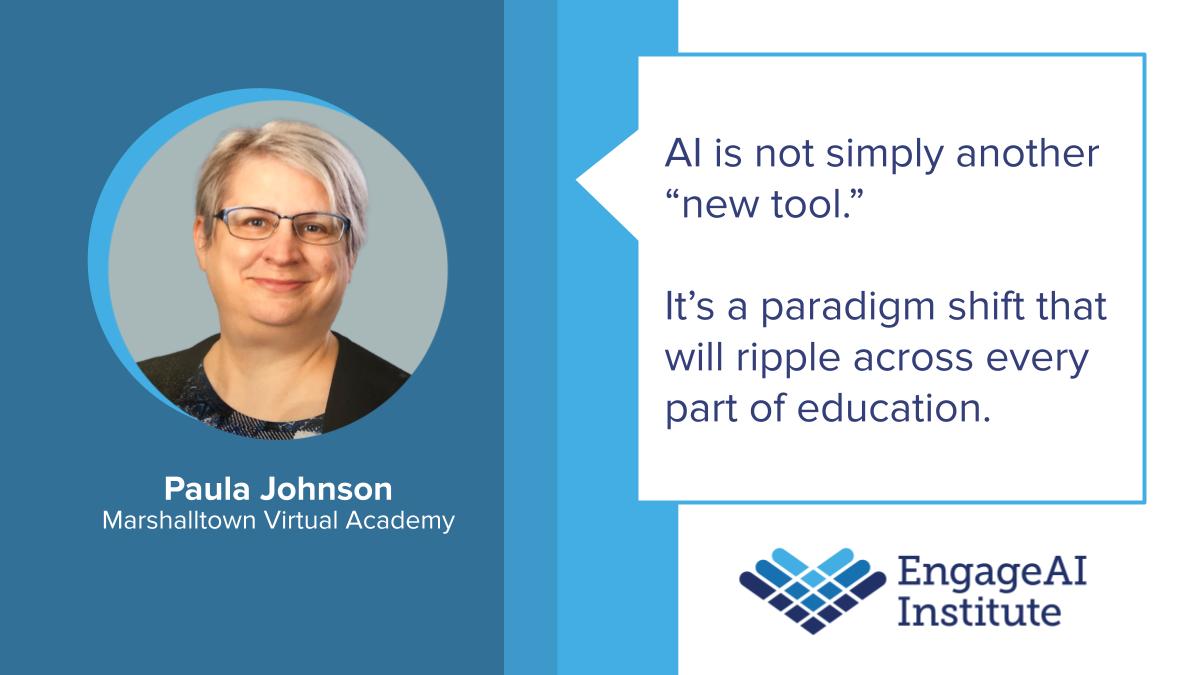
AI is not simply another “new tool.” It’s a paradigm shift that will ripple across every part of education. With that shift comes both promise and peril.
What I’ve learned is this: AI is not simply another “new tool.” It’s a paradigm shift that will ripple across every part of education. With that shift comes both promise and peril. On one hand, AI has the potential to personalize learning, reduce teacher workload, and open new opportunities for creativity. On the other hand, it raises serious ethical concerns about data privacy, equity of access, bias, and the risk of replacing human judgment with automated decisions.
The beauty of EngageAI is that it doesn’t shy away from these tensions. Instead, it invites educators like me into the conversation, trusting that those of us in classrooms, schools, and districts have vital insights to share. That’s the heart of educational leadership: not assuming we have all the answers, but being willing to stand in the complexity and contribute our voices anyway.
When I reflect on this journey, I don’t see it as a final chapter: I see it as a beginning. My work with Engage AI gave me the grounding and courage to take further steps: presenting on AI, writing about it, and supporting teachers as they explore what this means for their classrooms. Most importantly, it gave me the conviction that educators must be at the center of this work if we want AI in education to be equitable, ethical, and empowering.
Looking back, I’m grateful that my first step into AI leadership came through Engage AI. Looking ahead, I’m eager to keep walking this path because the work is too important to sit on the sidelines.
Visit Paula Johnson on Tech for more education technology insights.