Author: Yeo Jin Kim & Wookhee Min
Key Ideas
- Talking together does not always mean collaborating productively. Understanding collaborative problem solving requires looking at how students share information, reason with evidence, negotiate ideas, and coordinate their work.
- AI can reveal meaningful patterns in student dialogue. Analyzing how conversations unfold over time can uncover recurring patterns and identify collaborative behaviors connected to learning.
- Prediction is only part of the goal. Interpretable dialogue analysis can help explain what makes collaboration productive or unproductive and provide insights into where students may need support.
Beyond the Words
“That’s a good idea!”
At first glance, this sounds like a successful collaboration. One student has proposed an idea, and another agrees.
But imagine two conversations leading up to that response. In one, students compare evidence, question competing explanations, and reach a conclusion together. In the other, one student guesses an answer and everyone quickly agrees so they can move on.
The words are the same. The collaboration is not.
Understanding these differences is an important challenge in collaborative problem solving. Student conversations provide a window into how learners share information, reason with evidence, negotiate ideas, and coordinate their problem solving. The challenge is understanding what those conversations tell us about the quality of collaboration.
From Talk to Patterns
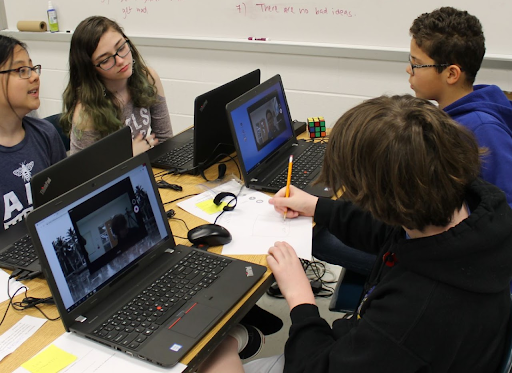
We investigate this challenge in EcoJourneys, an AI-enabled collaborative narrative-centered learning environment in which teams of middle school students investigate why fish are becoming ill in a virtual aquatic ecosystem. Students gather scientific information, evaluate evidence, develop explanations, and make decisions collaboratively.
Their conversations can take many forms. Students might build on one another’s ideas and compare evidence, but they might also agree without explaining their reasoning, participate unevenly, or struggle to make progress.
A single exchange rarely captures these differences. Collaboration unfolds through interactions over time.
Our research has therefore examined sequences of student dialogue to identify recurring patterns in how collaboration develops. We found patterns ranging from imbalanced participation and superficial negotiation to evidence-based collaboration and active engagement. These patterns were also connected to differences in group learning outcomes [1].
In other words, how students talk together can provide meaningful signals about how their collaborative learning is unfolding.
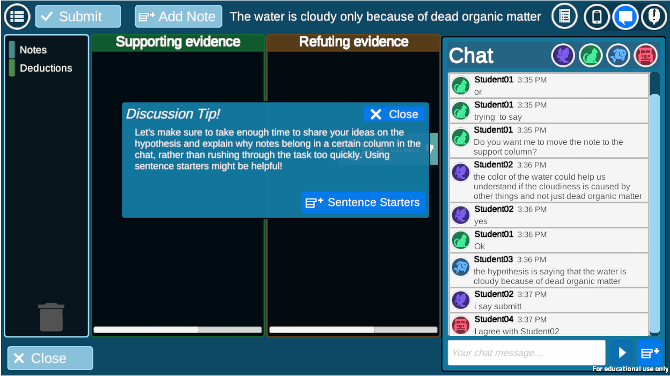
Figure 1. Adaptive Scaffolding Based on Students’ Collaborative Dialogue Analysis
Finding the Signals That Matter
Recognizing patterns is only the first step. Not every part of a conversation is equally informative about learning.
Our subsequent research examined which dialogue patterns were most closely connected to group learning outcomes. Several collaborative behaviors emerged as particularly important, including participation, evidence-based negotiation, and socially shared regulation—how students collectively plan, monitor, and coordinate their problem solving [2].
This moves us beyond asking how much students communicate. Instead, we can ask: Are different group members contributing? Are students examining evidence rather than simply accepting ideas? Are they working together to decide what to do next?
By focusing on learning-relevant dialogue patterns, AI can help identify which aspects of student interaction may matter for learning [2].
But if AI identifies that a group may be struggling, an important question remains: Why?
Prediction Isn’t Enough
Consider again: “That’s a good idea.”
Agreement may reflect shared understanding, but it can also occur when students accept an idea without discussing the reasoning or evidence behind it. Similarly, brief exchanges that appear rushed in isolation may actually reflect productive coordination.
Context matters. Our research distinguishes productive processes such as sharing task-relevant information, negotiating ideas, building shared understanding, and regulating group work from challenges such as insufficient reasoning, rushing task completion, unrelated conversation, and repeatedly struggling without progress [3].
These distinctions move beyond predicting whether collaboration is productive toward explaining what students are doing together. Two groups may both appear to be struggling, while one has uneven participation and another is actively discussing the task without enough reasoning. Those challenges may call for very different kinds of support.
Helping Educators Know Where to Look
Imagine several groups solving complex problems at the same time. One has a student who has stopped contributing. Another is actively talking but reaching conclusions without evidence. A third is productively comparing competing explanations.
A teacher cannot closely follow every conversation at once.
The goal is not to have AI decide whether students are collaborating “correctly.” Instead, collaborative dialogue analysis can make meaningful patterns more visible, helping educators understand where to look, what to look for, and where support may be most useful.
Across our research, we have moved from identifying how collaboration unfolds through dialogue [1], to finding patterns connected to learning [2], to explaining the collaborative processes behind productive and unproductive problem solving [3].
Because when a student says, “That’s a good idea,” the most important question may not be whether they agree.
It may be how they got there.
References
[1] Yeo Jin Kim, Daeun Hong, Wookhee Min, Snigdha Chaturvedi, Cindy E. Hmelo-Silver, and James Lester. Collaborative Problem-Solving Dialogue Analysis with Interpretable Temporal Clustering. Proceedings of the Twenty-Sixth International Conference on Artificial Intelligence in Education, Part III, pp. 30-44, Palermo, Italy, 2025.
[2] Yeo Jin Kim, Daeun Hong, Tianshu Wang, Wookhee Min, Snigdha Chaturvedi, Cindy E. Hmelo-Silver, and James Lester. A Dialogue-Based Learning Analytics Framework for Collaborative Game-Based Learning. Proceedings of the Sixteenth Symposium on Educational Advances in Artificial Intelligence, pp. 40840-40848, Singapore, 2026.
[3] Yeo Jin Kim, Daeun Hong, Xiaotian Zou, Wookhee Min, Snigdha Chaturvedi, Cindy E. Hmelo-Silver, and James Lester. Collaborative Dialogue Analysis for Productive Problem Solving. Proceedings of the Sixteenth International Learning Analytics and Knowledge Conference, pp. 283-293, Bergen, Norway, 2026.